Limiting Beliefs, Leadership, and the Indiana Football Rewrite

Indiana Football rewrite. From losers to champions

For most of my life, Indiana Hoosiers football has been a punchline.

A program known more for basketball banners than football wins. A place where hope showed up every September and quietly left by October. Generations of players, fans, and even administrators accepted a quiet agreement: This is just who we are.

And that’s how losing becomes permanent — not because of talent, but because of belief.

The Most Dangerous Sentence a Program (or Man) Can Say

“That’s just how it’s always been.”

When Indiana hired Curt Cignetti, they didn’t just hire a football coach.
They hired a belief disruptor.

Cignetti didn’t arrive talking about history. He didn’t talk about rebuilding eventually. He talked about standardssystems, and expectations — immediately.

One of his core philosophies is simple and uncomfortable:

“It’s not complicated. Players do their jobs. Coaches do their jobs. The system works.”

No mysticism. No motivational fluff. Just clarity.

And clarity is dangerous to excuses.

Indiana Wasn’t Broken — It Was Conditioned

Indiana football wasn’t lacking effort.
It wasn’t lacking facilities.
It wasn’t even lacking talent at times.

It was lacking permission to believe differently.

Cignetti’s approach has always been rooted in three things:

  1. Define the standard clearly
  2. Recruit and develop players who fit the standard
  3. Remove anyone — player or coach — who won’t live it

At previous stops, he proved this formula travels. New logo. New locker room. Same results.

Because systems beat motivation every time.

From Doormat to Dominance (Yes, Even 16–0 Feels Possible)

When belief changes, outcomes follow faster than logic can explain.

A 16–0 national championship season for Indiana football would have sounded delusional not long ago. Now? It sounds bold — and bold is where every breakthrough starts.

Not because Indiana magically became Alabama.

But because:

  • Expectations changed
  • Language changed
  • Accountability changed
  • The room changed

Winning didn’t start on Saturdays.
It started in meetingspractice habits, and how players talked to themselves and each other.

The Mirror Moment for the Rest of Us

This is where it gets personal.

Most men I talk to aren’t losing because they’re lazy.

They’re losing because:

  • They’ve accepted an identity that no longer serves them
  • They’ve surrounded themselves with people who normalize average
  • They rehearse the same limiting thoughts every morning

“I’m behind.”
“I missed my window.”
“This is just how life is with kids.”

Sound familiar?

Indiana football believed it was a loser program — until someone refused to speak that language anymore.

Belief Is a System, Not a Feeling

Here’s the hard truth:

You don’t rise to the level of your goals.
You fall to the level of your belief systems.

  • What do you expect from yourself as a husband?
  • What do you tolerate in your fitness?
  • What conversations dominate your circle of friends?
  • What standards do you enforce when no one’s watching?

Cignetti didn’t motivate Indiana to win.
He engineered belief through structure.

That’s available to all of us.

Final Thought

Indiana football didn’t change because they wanted it more.

They changed because someone finally said:

“We are not who you think we are.”

If you’re stuck — financially, physically, spiritually, or relationally — ask yourself this:

What belief am I protecting that’s costing me my future?

Sometimes the breakthrough isn’t a new strategy.

It’s a new standard.

And the courage to live up to it.

Motivation is a Crutch for Undisciplined Men

Most men think their problem is motivation.

Why can’t I get motivated?

They’re waiting to feel ready.
Waiting to feel driven.
Waiting to feel like today is the day.

But the truth is simpler and harder to admit:

If your plan depends on motivation, it’s already unstable.

Motivation is a feeling.
Feelings change. Quickly!

And busy weeks don’t care what you feel like doing. Especially when you’re a father, husband, business operator/employee.


Why Motivation Fails Under Pressure

Motivation shows up when:

  • Life is calm
  • Sleep is good
  • Stress is low
  • The future feels exciting

But that’s not real life most of the time. At least it’s not for me.

Real life looks like:

  • Early mornings and late nights
  • Work that doesn’t slow down
  • Kids who need you when you’re tired
  • Unexpected problems that don’t wait for perfect timing

Motivation disappears under weight.
Structure doesn’t.

That’s why men who rely on motivation feel strong in January…
and lost or confused by March.


Discipline Isn’t Harsh — It’s Reliable

A lot of men secretly think discipline is punishment. I know I’ve felt this way. I used to workout

Discipline was something rigid.
Something joyless.
Something you “power through.” Cameron Hanes says, “nobody cares, work harder”

That belief guarantees burnout. At least for me.

Discipline isn’t punishment.
It’s what keeps you moving when life gets loud. Jocko Willink wrote about this in, “Discipline equals Freedom”

Not dramatic.
Not impressive.
Just steady. The more disciplined. The more space created freedom.

Discipline is how you keep promises to yourself when no one is watching. <—– oooohhh. I like that. Keep promises.


Micro Habits Beat Big Intentions

Here’s where most men go wrong.

They design habits for their best days.

Then life hands them average days.
Or hard ones.

And the whole system collapses.

Micro habits are built for reality.

They’re small enough to survive every day life:

  • Bad sleep
  • Heavy schedules
  • Stressful seasons
  • Low energy

They don’t aim to impress.
They aim to endure. They aim to sustain momentum.


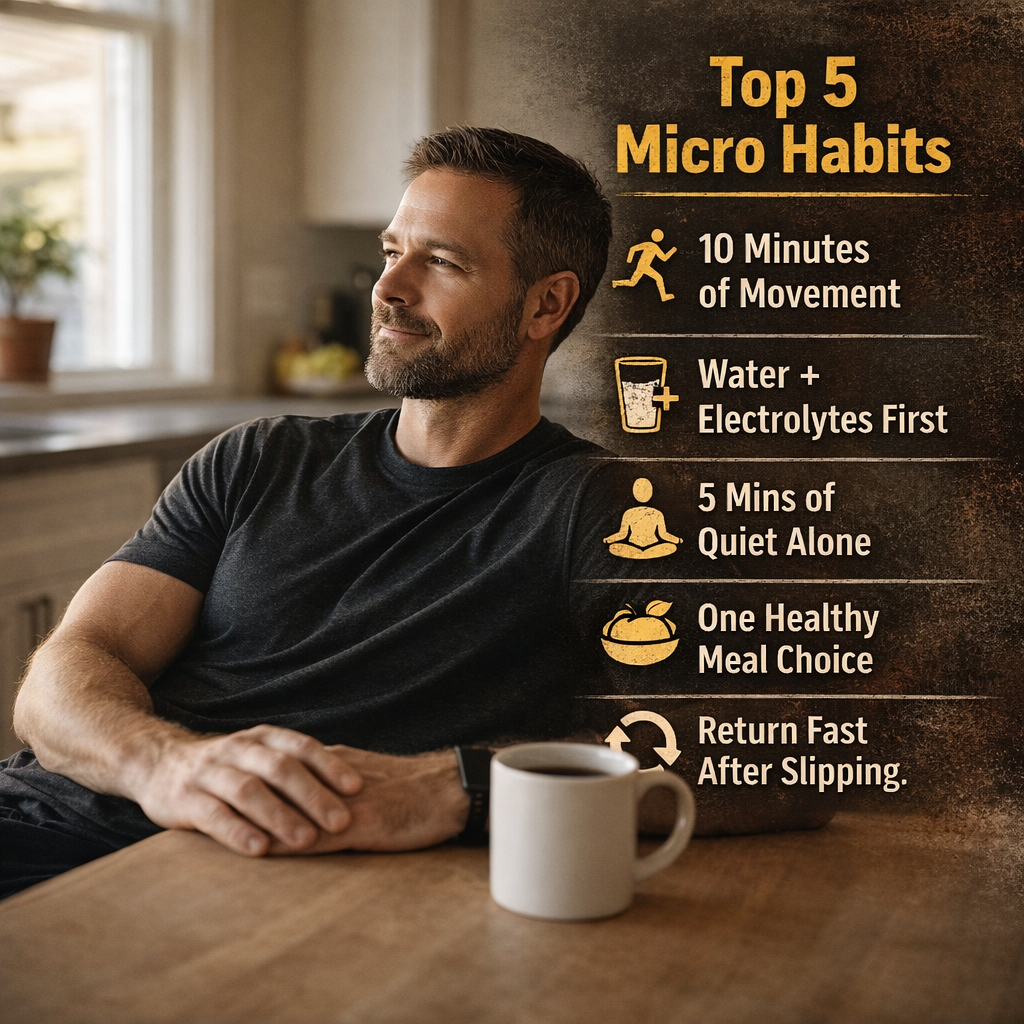
The Top 5 Micro Habits That Survive Busy Weeks

These aren’t optimal.
They’re durable.

They’re built to work when life doesn’t cooperate.

1. Ten Minutes of Movement

Not a workout.
Just movement.

Walk. Stretch. Push-ups. Anything.

The goal isn’t fitness — it’s identity:
“I’m the kind of man who moves his body, even when I’m busy.”


2. One Glass of Water Before Anything Else

Before coffee.
Before your phone.
Before the day grabs you.

It’s not about hydration alone.
It’s about starting with a decision you control.


3. Five Quiet Minutes Before Noise

No phone.
No news.
No inbox.

Just stillness. Thought. Prayer. Breathing.

The last 40+ days, I’ve started my day with a Wim Hof style breathing. Three rounds. Non-negotiable.

It’s not spiritual heroics.
It’s mental alignment.


4. One Intentional Meal Choice

Not a perfect day of eating.
Just one good choice. For this I start my day with 30g of protein. Forms include: Overnight Oats (most frequent), a smoothie, or quick shake.

I make it the night before so I don’t have to think.

It reminds you that discipline isn’t all-or-nothing.
It’s one decision at a time. Every day.


5. Return Fast After You Slip

This might be the most important habit of all.

You will miss days.
You will fall off.
You will get inconsistent.

The habit isn’t perfection.
It’s speed of return. Again, momentum is easier harnesses than restarting.

“Never miss twice” matters more than never missing.

“I’m the type of man who <insert discipline>” no matter what


Why This Actually Works

Big goals collapse under pressure.
Micro habits adapt.

They don’t rely on:

  • Energy
  • Excitement
  • Perfect timing

They rely on:

  • Simplicity
  • Repetition
  • Identity [Promises Kept]

Every small habit is a vote for the man you’re becoming.

Not in speeches.
In actions.


A Quiet Reality Check

If your discipline only works when life is easy,
it isn’t discipline.

It’s convenience.

The test isn’t your best days.
It’s your busiest ones.

That’s where your real system shows up.


The Question That Matters

What’s the smallest habit you can keep
even when life is heavy
that proves you’re not quitting on yourself?

Start there.

Create momentum then stack another.

Not because it’s impressive.
But because it lasts.

Foundational Shifts: When Business Stops Being Linear

“Businessman pushing a boulder labeled ‘effort’ uphill while another stands on a lever facing a city skyline, symbolizing moving from hard work to leverage and systems.”

The last 60 days have stretched my thinking in ways I didn’t fully anticipate.

This week alone, I was on a call solutioning ideas with people in Colombia. I was resourcing scale options with someone in India. I was being trafficked—guided, supported, kept moving—by a virtual assistant in the Philippines. All of it happening while building out an e-commerce brand I can’t wait to share.

At first, it hit me as shocking.

Then I realized… it really shouldn’t be.

Years ago, Tim Ferriss talked about this in The 4-Hour Workweek—offshoring, leverage, designing life instead of reacting to it. Back then, it felt futuristic. Almost irresponsible.

Now? It’s normal. It’s table stakes.

The Epiphany: Linear Thinking Is the Ceiling

Friday morning I was speaking with an entrepreneur/founder who challenged me in a way I didn’t know I needed.

He wasn’t criticizing my work ethic.
He wasn’t questioning my ambition.

He was questioning my math.

Linear thinking had quietly become my limiter.

I was thinking:

  • More effort = more output
  • More hours = more progress
  • More control = more safety

But the world no longer rewards that model.

The shift is exponential:

  • Better systems beat harder work
  • Better leverage beats longer days
  • Better collaboration beats tighter grip

That conversation was an aha moment—almost an epiphany. The world didn’t slowly change. It fundamentally changed. And if we don’t see that, we’ll unknowingly fight yesterday’s battles with today’s tools.

Leaving a Chapter Isn’t Failure

I’m so genuinely grateful for the line of work I came from. It shaped me. It fed my family. It taught me discipline and opened my eyes to yet another door in the media ecosystem.

But I also felt… boxed in.

Not because it was wrong.
Not because anyone else was wrong.

I just felt held back and I couldn’t punch through without breaking myself.

Stepping into this new world feels different.

Limitless, honestly.

  • Production capabilities? Endless.
  • Creativity? Spiking.
  • Storytelling? Amplified.

And here’s the part that matters most to me: none of this requires abandoning who you are or what you believe.

In fact, the more scalable the world becomes, the more valuable a grounded narrative is. Your beliefs. Your faith. Your integrity. Your real story.

Bigger Thinking, Deeper Roots

As a creator, a builder, a husband, a father—I can’t afford to think linear anymore.

Not for ego.
Not for money alone.
But for impact.

The playing field is bigger now. The barriers are lower. The speed is faster. And the responsibility is heavier.

“Success leaves clues”, I repeat it often…and they are everywhere!!

We can provide more value to more people than ever before—but only if we let go of outdated frameworks that quietly keep us safe and small.

This is an exciting time.

A destabilizing time.
A stretching time.
A faith-testing time.

Hold on tight.

Not because it’s scary—but because if you’re paying attention, you’re about to see just how big the world really is.

The Most Dangerous Lie Christian Men Believe About Ambition

There have been many a season where I questioned my own ambition.

Not in a dramatic way. Quietly.
The kind of questioning that doesn’t show up in conversations, but lingers during long drives or late nights.

I was doing “the right things.”
Faith. Family. Work. Responsibility.

And yet, every time I felt the pull to grow, to build more, earn more, stretch further… there was a subtle tension underneath it all.

Is this godly… or selfish?
Am I trusting God… or chasing control?
At what point does ambition cross a line?

I’ve seen this tension play out in a lot of good men. Men who love their wives. Men who show up for their kids. Men who take their faith seriously.

And over time, I’ve realized there’s a lie sitting quietly at the center of it.


The Lie Sounds Like This

“If I truly trust God, I shouldn’t want more.”

It rarely shows up that cleanly.
It usually disguises itself as wisdom, humility, or contentment.

It sounds like:

  • “I’m just trying to be grateful for what I have.”
  • “I don’t want money to become an idol.” – been there!
  • “I don’t want ambition to pull me away from what matters.” – absolutely lived this!!

On the surface, that all sounds reasonable.

But watch what I experienced next.

Opportunities get delayed.
Growth gets postponed.
Potential gets parked in the name of being “faithful.”

Not because a man is lazy.
But because he’s afraid of wanting the wrong thing.


Why This Lie Is So Comfortable

This lie offers protection.

If you keep your ambition small:

  • You don’t have to risk failing publicly.
  • You don’t have to manage increased responsibility.
  • You don’t have to confront the parts of your life that might not scale well.

It feels spiritually safe.

You can call it patience instead of fear.
You can call it trust instead of avoidance.
You can call it humility instead of hesitation.

But over time, something subtle happens.

Men don’t become more peaceful. They become restrained.
Not surrendered. Just smaller.


Ambition Isn’t the Problem

Here’s the reframe that changed things for me:

Ambition isn’t the enemy of faith.
Misalignment is.

Ambition is a force, like fire.
It can warm a home or burn it down.

The issue isn’t whether you have ambition.
It’s whether your ambition is ordered or avoided.

Faith doesn’t cancel desire.
It directs it.

When ambition runs without alignment, it destroys things. I know I’ve felt this.
When ambition is avoided altogether, it erodes things just as quietly. “without purpose the people perish”


Small Thinking Doesn’t Protect You

This was a hard one to accept.

Playing small doesn’t actually keep your soul safe.

It doesn’t strengthen your marriage.
It doesn’t make your kids more secure.
It doesn’t remove pressure — it redistributes it.

Often onto:

  • A spouse carrying more emotional load
  • A future version of you with fewer options
  • A family dependent on systems instead of leadership

Avoiding growth doesn’t remove responsibility.
It just delays the bill.


Growth Reveals What Needs Strengthening

Here’s something I’ve noticed consistently:

Growth doesn’t corrupt character.
It exposes formation gaps.

More responsibility doesn’t create misalignment — it reveals it.

  • If your body breaks down under pressure, that’s feedback.
  • If your marriage strains, that’s information.
  • If your faith feels thin, that’s an invitation — not a condemnation.

Pressure isn’t proof you’re doing something wrong.
It’s often proof you’re carrying something meaningful.


A Quiet Self-Audit

Here are few questions worth sitting with:

  • Where have I labeled fear as faith?
  • What opportunity am I postponing until I “feel clearer,” even though clarity usually comes after movement? (mood follows action)
  • If my ambition doubled tomorrow, what part of my life would break first?

Those answers matter more than any tactic.


A Different Way to Think About It

God doesn’t ask men to want less.

He asks them to want what lasts.

To carry responsibility without apology.
To pursue growth without losing alignment.
To lead without shrinking themselves in the process.

The question isn’t whether you’re ambitious.

It’s whether you’re willing to steward what you’ve already been given?

Why New Year’s Resolutions Rarely Survive January

January is full of good intentions.

Motivation is high.
Ambition feels clean.
The future looks wide open.

This is the season where people decide who they’re going to become.

And it’s also the season where most of those decisions quietly fall apart.

Not because people don’t want change badly enough.
But because they misunderstand what actually sustains it.


Mistake #1: Building a Resolution on Motivation

New Year’s resolutions assume something that won’t last:

That you’ll feel like this later.

You won’t.

Motivation is a temporary state. Andrew Huberman explains it biologically, dopamine spikes with novelty, then normalizes. James Clear says it more practically: motivation gets you started, but it won’t keep you going.

That’s why January feels powerful.
And March feels heavy.

If your plan depends on how you feel, it’s already fragile.

Micro habits solve this by removing emotion from the equation.
They’re small enough to execute even when motivation disappears.


Mistake #2: Aiming for Transformation Instead of Continuity

Most resolutions aim for dramatic change. I know…I’ve tried it.
WHO HASN’T??

New body.
New discipline.
New lifestyle.

But life doesn’t pause just because the calendar flips.

Stress shows up.
Sleep gets disrupted.
Kids get sick.
Work gets heavy.

And when the plan requires perfect conditions, it collapses. Momentum lost.

James Clear talks about habits needing to be “small enough to succeed on your worst days.” That idea matters more than most people realize. I like to think of it as a dimmer switch. Not fully [OFF], just dialed back

Because consistency isn’t built on great weeks.
It’s built on imperfect ones.

Micro habits keep you in motion, even when progress feels small.
They don’t demand intensity — they preserve continuity.


Mistake #3: Treating Falling Off Track as Failure

This might be the most damaging mistake of all.

Most resolutions don’t fail because people quit.
They fail because people miss a day — and then decide it’s over.

All-or-nothing thinking turns one disruption into abandonment.

But real life doesn’t reward perfection.
It rewards consistency.

A good system doesn’t shame you for falling off.
It makes it easy to start again.

Micro habits lower the barrier to re-entry.
They invite you back instead of punishing you for slipping.


Why Habits Decide the Year — Not Goals

By the first week of January, something important has already started happening.

Not visibly.
Not dramatically.

But quietly, your habits have begun shaping the year.

Not your resolutions.
Not your ambitions.
Your defaults.

What you do when things are busy.
What you return to when life knocks you sideways.
What you choose when no one is watching.

That’s where the year is actually decided.


Small Anchors Create Long-Term Change

Micro habits aren’t impressive.

They won’t make a highlight reel.
They won’t feel transformative in the moment.

But they do one essential thing: they keep you aligned.

Ten minutes of movement.
One glass of water before coffee.
Five minutes of quiet before checking your phone.
One intentional decision when stress hits.

These aren’t finish lines.
They’re anchors for consistent momentum.


This Is How the Year Is Won

Not in January enthusiasm.
Not in bold declarations.

But in March, when progress feels slow.
In July, when routines loosen.
In August, when discipline feels optional.

Big outcomes aren’t built on big resolutions.

They’re built on small habits you refuse to abandon.

So the better question this year isn’t:

What do I want to change?

It’s this:

What’s the smallest habit I can keep — even on my worst days — that keeps me aligned with the man I’m trying to become?

That answer will carry you a lot further than motivation ever will.
~Cheers to a new year!

The Most Important Question of Your Life

I came across this Mark Manson post from a link, shared by Tim Ferriss in his 2025 [Five-Bullet-Friday] recap. He stated he could read it once a week, every week, for the rest of his life and still find value every time.

That’s saying something.

Instead of waxing on and on about how I feel about it, I figured I’d just shared the wealth here.

https://markmanson.net/question – please read or listen 2x. It’s worth really absorbing the question asked.

PS – I really like the “Listen to this article” function and I’m considering building that in. I love the passive nature of learning while exercising, etc.

~Happy New Year to all my readers!