Why New Year’s Resolutions Rarely Survive January

January is full of good intentions.

Motivation is high.
Ambition feels clean.
The future looks wide open.

This is the season where people decide who they’re going to become.

And it’s also the season where most of those decisions quietly fall apart.

Not because people don’t want change badly enough.
But because they misunderstand what actually sustains it.


Mistake #1: Building a Resolution on Motivation

New Year’s resolutions assume something that won’t last:

That you’ll feel like this later.

You won’t.

Motivation is a temporary state. Andrew Huberman explains it biologically, dopamine spikes with novelty, then normalizes. James Clear says it more practically: motivation gets you started, but it won’t keep you going.

That’s why January feels powerful.
And March feels heavy.

If your plan depends on how you feel, it’s already fragile.

Micro habits solve this by removing emotion from the equation.
They’re small enough to execute even when motivation disappears.


Mistake #2: Aiming for Transformation Instead of Continuity

Most resolutions aim for dramatic change. I know…I’ve tried it.
WHO HASN’T??

New body.
New discipline.
New lifestyle.

But life doesn’t pause just because the calendar flips.

Stress shows up.
Sleep gets disrupted.
Kids get sick.
Work gets heavy.

And when the plan requires perfect conditions, it collapses. Momentum lost.

James Clear talks about habits needing to be “small enough to succeed on your worst days.” That idea matters more than most people realize. I like to think of it as a dimmer switch. Not fully [OFF], just dialed back

Because consistency isn’t built on great weeks.
It’s built on imperfect ones.

Micro habits keep you in motion, even when progress feels small.
They don’t demand intensity — they preserve continuity.


Mistake #3: Treating Falling Off Track as Failure

This might be the most damaging mistake of all.

Most resolutions don’t fail because people quit.
They fail because people miss a day — and then decide it’s over.

All-or-nothing thinking turns one disruption into abandonment.

But real life doesn’t reward perfection.
It rewards consistency.

A good system doesn’t shame you for falling off.
It makes it easy to start again.

Micro habits lower the barrier to re-entry.
They invite you back instead of punishing you for slipping.


Why Habits Decide the Year — Not Goals

By the first week of January, something important has already started happening.

Not visibly.
Not dramatically.

But quietly, your habits have begun shaping the year.

Not your resolutions.
Not your ambitions.
Your defaults.

What you do when things are busy.
What you return to when life knocks you sideways.
What you choose when no one is watching.

That’s where the year is actually decided.


Small Anchors Create Long-Term Change

Micro habits aren’t impressive.

They won’t make a highlight reel.
They won’t feel transformative in the moment.

But they do one essential thing: they keep you aligned.

Ten minutes of movement.
One glass of water before coffee.
Five minutes of quiet before checking your phone.
One intentional decision when stress hits.

These aren’t finish lines.
They’re anchors for consistent momentum.


This Is How the Year Is Won

Not in January enthusiasm.
Not in bold declarations.

But in March, when progress feels slow.
In July, when routines loosen.
In August, when discipline feels optional.

Big outcomes aren’t built on big resolutions.

They’re built on small habits you refuse to abandon.

So the better question this year isn’t:

What do I want to change?

It’s this:

What’s the smallest habit I can keep — even on my worst days — that keeps me aligned with the man I’m trying to become?

That answer will carry you a lot further than motivation ever will.
~Cheers to a new year!

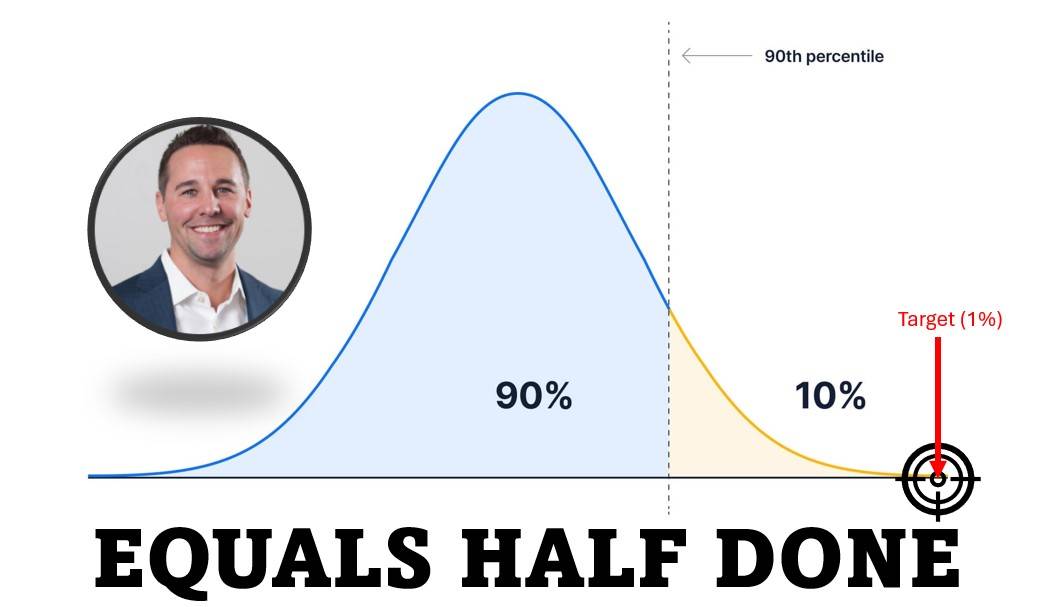
Top 90%, Equals Half Done

The title almost seems counter intuitive, or some sort of Jedi mind trick, but it’s not.

I was listening to the Ed Mylett Show this morning working out and the topic was: Dream It, Live It, Write It. The first 10 minutes of the podcast Ed laid out the landscape of being a top 10% achiever, or said alternatively, being 90% better than the population at a given goal or discipline. This could be fitness, could be income, could be NET WORTH, or it could be intelligence. The Top 10% (the 90th percentile) is a worthwhile position. But Ed stated the following challenge, being in the top 10%, you’re only 50% of the way done…unless you’re done growing!

I rewound the podcast. I listened again.

Ed goes on to state a recipe of what’s necessary to find yourself in the top 10%. Show up. Have a good attitude. Commit with Consistency. Nothing world beating, but it does take focus and effort. But the change necessary to leap from the top 10% to the top 1%, that’s going to take much more. New Levels, New Devils.

I rewound the podcast, and I listened yet again. I started to question where I was. Am I after a top 10% life, or a top 1% life?

Lets look for some data points

The top 10% of income earners in the United States achieve an income of $167,639 annually. Depending on where you search, you can also find a different answer depending on age/location/etc. But for the sake of moving forward, the $167K is a good beacon. But what does the top 1% earn? USA Today says that number is $788,000. Therefore to move from the top 10% to the top 1%, a person must not just double their income, they must 5X it!!

What about fitness? The Mayo Clinic offers some standards for basic fitness here which is a good guide to starting. This is great intel in communicating fitness “standards”, but it doesn’t give me top 10% vs. top 1%. So the search continues. Even better, lets take a trip back to the President’s National Fitness Standards of 1985. “Participants must at least reach these levels in all 5 events in order to qualify for the Presidential Physical Fitness Award. These levels represent the 85th percentile based on the 1985 School
Population Fitness Survey.” Whatever happened to these anyway? Any correlations to these standards disappearing and our kids getting fatter than ever? Another argument for another day.

Sadly enough, the bad news continues. I heard this obesity statistic and couldn’t help but share (mostly out of rage). The United States is a HORRIBLE barometer. More than 2 in 5 adults (42.4%) have obesity. That’s disgusting. Just being in the top 1/2 in the US means you’re likely “not” obese. Congrats. End of Rant!! BMI can also be a good indicator, although not directly categorized by top 10% vs. top 1% here.

How about running?!? Mile times give us a little cleaner look in the top 50% vs. top 1% here from Medical News Today. Top 50% of males my age run a 9:54 mile. But the top 1% run a 7:00 mile. Not gospel, but again a good beacon to think about what it really takes to be top 1%.

The last stone I was looking to overturn was intelligence. It’s been a while (24 years) since taking the ACT, but a top 10% score is 29+, and a top 1% score is 35+ (36 perfect score). Isn’t that word perfect a trigger? It is sure as hell is for me!! I’m not trying to be perfect, nor do I think I can get there. I’m trying to maximize my best.

What will it take?

New Year’s Day, brings with it new year’s resolutions. I hate new year’s resolutions because they flat out don’t work. More often they’re a plea, and they don’t change behavior. Turning the page on the calendar to create “anew” version of oneself requires real change.

The first part about creating change is understanding and committing to a MASSIVE why behind the change we’re looking to make. Commit to the WHY, the how will present itself.

For me, I need to understand WHY I want to live a 1% life vs. a 10% life? More specifically, I’ve learned from Tony Robbins, I don’t just want a 1% life, I want how a 1% life makes me FEEL!

~Cheers to another year in pursuit!